
Tank + Well Radio Link
A cost-effective, reliable & automated water transfer system over long distances with no line-of-sight, using a mix of Edge hardware, Radio, and Cloud connectivity on existing well equipment.
The Challenge: Legacy Pressure Systems
Older well systems pumping to hilltop storage tanks rely on mechanical pressure switches, air-diaphragm booster tanks, and float valves to automate filling.
Inside the storage tank, the float valve opens when the water level is low. This opening action causes a loss of water pressure in the fill pipe and booster tank, which triggers the pressure switch to turn the well pump on.
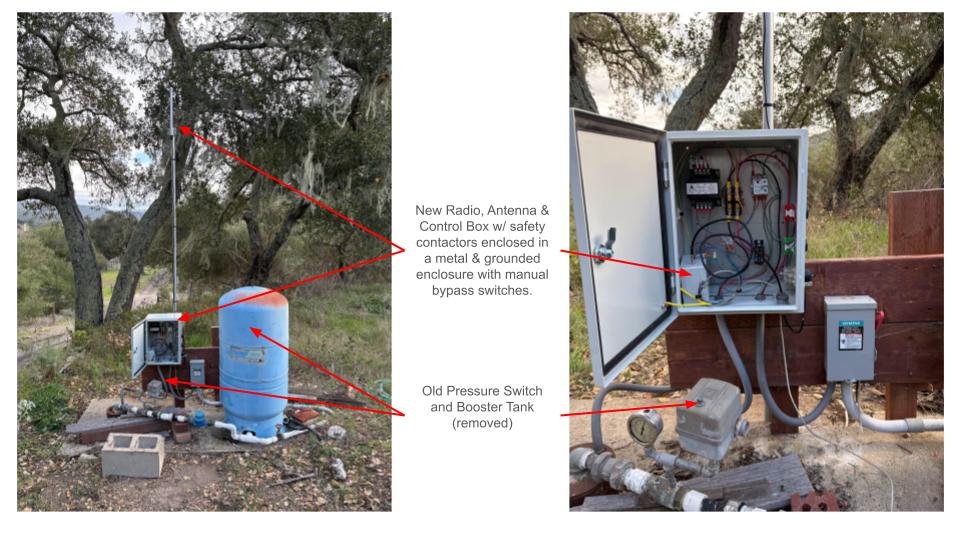
Once the tank is full, the float valve closes, causing water pressure to build inside the fill pipe and booster tank, reversing the action on the pressure switch, which turns the well pump off.
Booster tanks have internal air-filled diaphragms to hold higher water pressure, which reduces rapid cycling of the pressure switch and well pump.
The repeated stress of pressure loss and recovery in this type of system requires routine calibration of the pressure switch, float valve, and booster tank. This is a time-consuming and skilled process that involves not just checking the spring tension on the mechanical pressure switch, but also balancing the internal air pressure inside the booster tank and clearing any build-up of solids from the float valve inside a large tank in a remote location.
Furthermore, raw well water has high levels of calcium, manganese, and other hard minerals that cause scaling of these mechanical components, tanks, and pipes. Typically, most sites do not treat raw well water at the well location before it reaches these control components. Consequently, when these designs fail, the repair is most often a new installation of all components, which repeats the lifecycle ad nauseam.
The Solution: The 21st-Century Radio Link
Alternatives to pressure systems involve either running underground wire to internal tank floats that control pump relays, or using radio links, which remove all pressure-related components and their associated maintenance. However, in the wired design, installation involves substantial labor on hillsides in remote areas, underground conduit, and copper wire.
Radio links have the same benefit of removing the pressure components, but also add 21st-century digital benefits such as long-range, non-line-of-sight communication, remote monitoring, power savings through demand-response, remote operation, and integration into other radio-controlled devices.
System Architecture
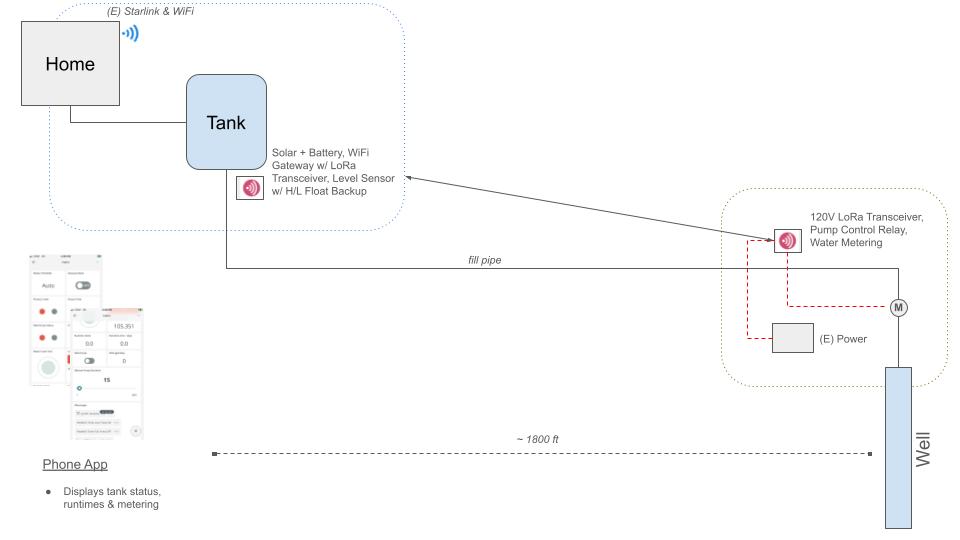
Our radio systems use a mix of unlicensed radio bands in MURS VHF or 915MHz LoRa to bridge physical barriers between device locations up to several miles apart. The radios are multi-way communicating devices with site-specific packet headers, packet validation and command call-back validation to eliminate false starts, false signals or conflicts in noisy environments.
Well Pump Control & Radio Link
This node is designed for reliable pump activation, pump monitoring through external sensors, and water & flow metering utilizing on-chip edge detection. By monitoring flow rates, the Well Node can sense a sudden loss of flow indicating dry well, pump cavitation, and send an alarm through the radio to the internet gateway.
- LoRa Radio Transceiver (multi-way)
- Pump Control Relay
- Pump Operation Sensor
- Water Metering & Flow Rates
- Auto Shut-off from Sudden Flow Loss, Pump Cavitation
Storage Tank Sensor & Radio Link (with Wi-Fi Gateway)
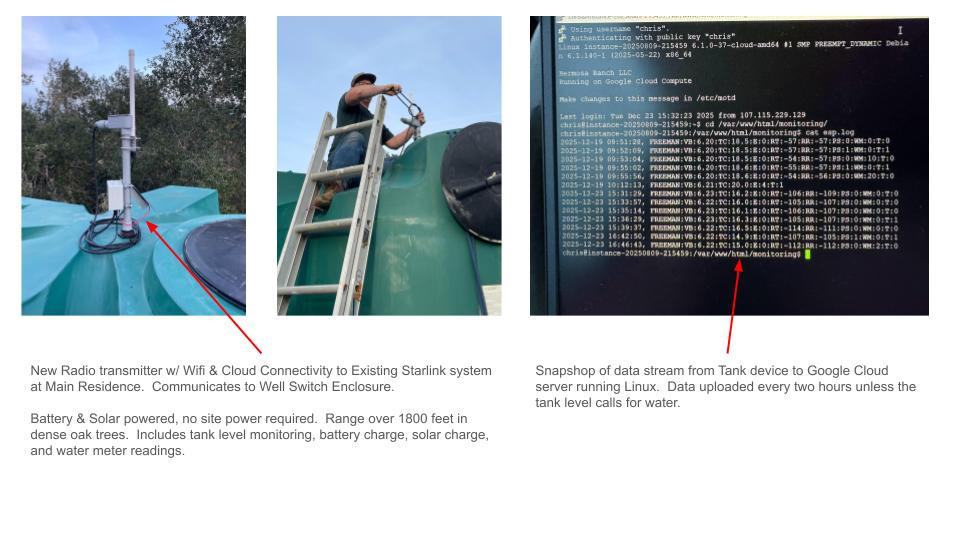
Operating on stand-alone solar power at less than 6 Volts micro-amp, this node acts as the system's brain and communication bridge to our Cloud server.
- Solar + Battery Power (safe 6 Volts, micro-amp)
- WiFi Gateway with LoRa Transceiver
- Primary Level Sensor for Real-time Tank Levels w/ 12-bit (sub inch) Resolution
- High/Low Float Backup for Fail-safe Redundancy
User Interface & Control
The customer interacts with the entire system via a dedicated Phone App. This provides real-time visibility into:
- Live Tank Status
- Pump Runtimes
- Water Metering metrics